

Most dashboards tell you what happened, not where it matters
Business dashboards are good at summarizing performance. They show totals, averages and trends. What they often fail to show is where those numbers come from, and why that matters.
Two regions can deliver the same revenue. One may be growing steadily across many customers, the other propped up by a single outlier. A service metric can look healthy overall while hiding local hotspots of failure. These differences matter, because they lead to very different decisions.
Geo-analytics exists to close this gap. It adds location and spatial context to data, helping organizations understand not just what is happening, but where, why, and what to do about it.
What do we mean by geo-analytics?
Geo-analytics, also known as geospatial analytics or location intelligence, is the analysis of data that includes a geographic dimension. This could be a point on a map, a postcode, a sales territory, or a service area.
The important distinction is intent. Geo-analytics is not about placing data on a map for presentation. It is about treating location as a first-class analytical dimension, alongside time, category and measure.
When location becomes part of analysis rather than an afterthought, new questions and insights emerge naturally.
Why location adds context ordinary data cannot
Most business metrics only tell part of the story when viewed in isolation. Location provides context that helps explain why those metrics look the way they do.
For example:
- Sales performance can appear stable overall while masking sharp regional variation.
- Customer churn may be driven by local service issues rather than product quality.
- Costs can differ dramatically due to distance, density or regional constraints.
Location turns abstract figures into something grounded in the real world. It helps decision-makers move from “what happened?” to “what is really going on here?”
The kinds of business questions geo-analytics answers well
Many strategic and operational questions are inherently spatial, even if they are not framed that way.
Geo-analytics helps answer questions such as:
- Where are our customers, assets or operations actually concentrated?
- Which regions are underperforming relative to their peers?
- Where do we see clusters, gaps or unusual behavior?
- How well do we cover a market or serve a population?
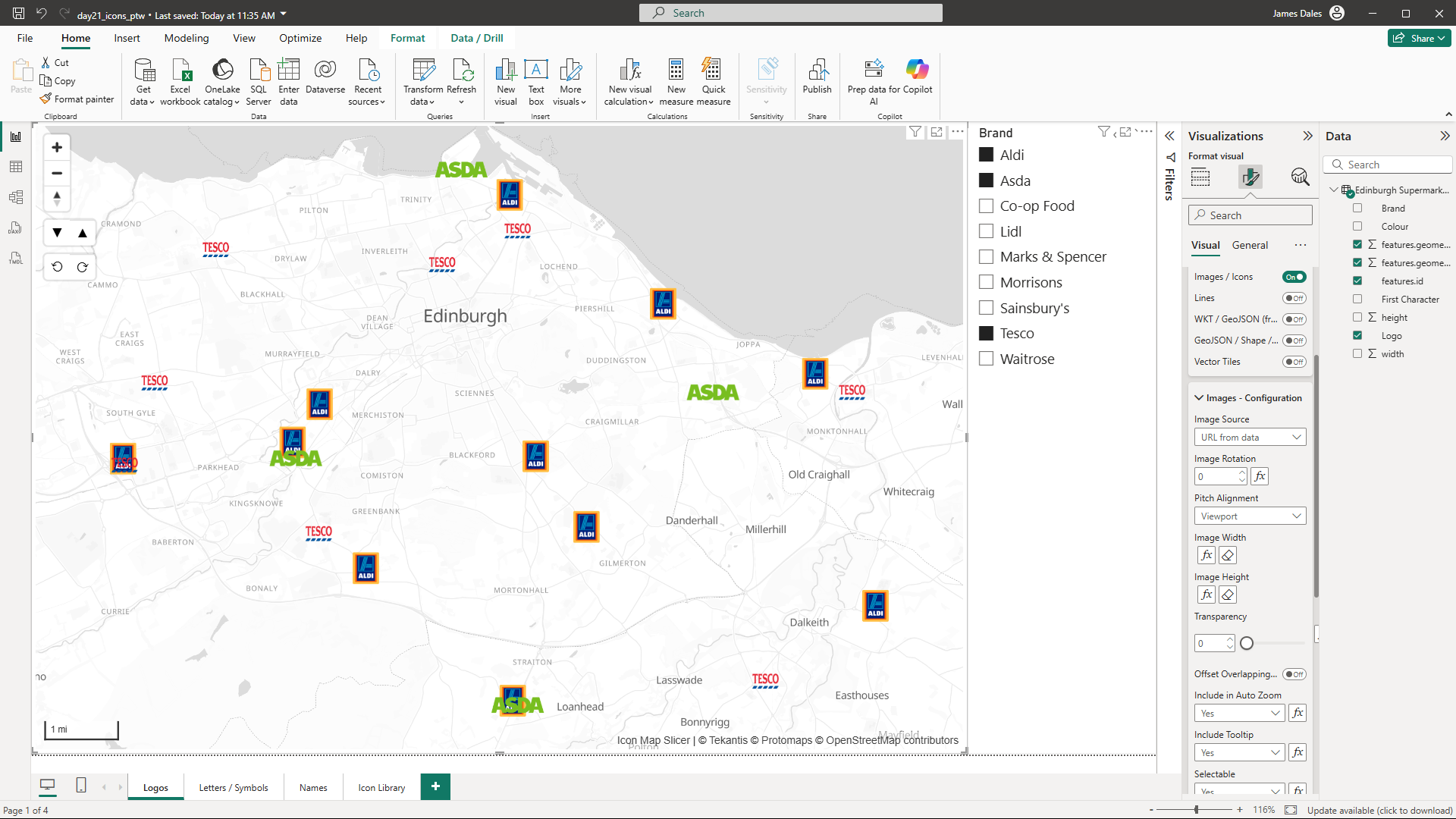
These are everyday business questions. Without spatial analysis, they are often answered using proxies, assumptions or oversimplified averages.
Seeing movement, proximity and interaction
Location is not just static. Many important patterns involve movement and interaction between places.
Examples include:
- How far customers travel to access a service
- How goods move through supply chains
- Which locations influence others
- Where proximity creates risk, cost or opportunity
Traditional tables and charts struggle to represent these relationships. Geo-analytics makes them visible, measurable and comparable, enabling more informed planning and optimization.
Why maps are analytical tools, not just visualizations
Maps are often dismissed as decorative or explanatory. In reality, an analytical map is a thinking tool.
An analytical map allows users to:
- Compare performance across regions
- Aggregate data spatially in meaningful ways
- Layer multiple datasets to explore relationships
- Filter and drill into specific locations
- Identify clusters, outliers and patterns that are hard to see otherwise
In this sense, maps play the same role as charts and tables, but for spatial questions. They support exploration, hypothesis testing and decision-making, not just presentation.
Geo-analytics inside modern BI tools
For many years, geospatial analysis lived in specialist GIS tools, separate from mainstream business intelligence. That separation created friction. Location insight was harder to access, harder to govern and often disconnected from core metrics.
Today, platforms like Power BI are the primary analytics interface for many organizations. Business users expect spatial insight to sit alongside financial, operational and customer data, using the same security, refresh and governance processes.
Embedding geo-analytics within BI tools makes location intelligence more accessible and more relevant to everyday decisions.
Why geo-analytics matters now: the rise of cloud-native data platforms
Geo-analytics has existed for decades, but it is becoming strategically important now because of changes in the data platform.
Modern cloud data platforms are built around scalable object storage, open formats and distributed compute. Historically, geospatial data did not fit well into this model. It required specialist formats and separate infrastructure.
That is changing. Cloud-native geospatial formats such as GeoParquet, Cloud Optimized GeoTIFFs (COGs) and modern vector tile standards are designed to work with the same technologies that underpin today’s analytics platforms.
This convergence has important consequences:
- Geospatial and non-spatial data can live side by side in the same platform
- The same storage, compute and governance patterns apply to both
- Analysts can work with location data without leaving the analytics stack
As a result, geo-analytics is no longer a niche capability. It becomes part of the core data platform strategy, and a natural focus for organizations investing in modern analytics.
A practical example: Icon Map and cloud-native geo
Icon Map is built around this cloud-native approach to geo-analytics. It brings advanced spatial capability directly into Power BI, aligned with open, scalable data formats rather than proprietary silos.
For example:
- PMTiles enable efficient delivery of large vector datasets
- GeoParquet supports analytical geospatial data at scale
- Cloud Optimized GeoTIFFs (COGs) handle raster data in cloud storage
By building on these formats, Icon Map fits naturally into modern data platforms. Spatial data follows the same patterns as other analytics data, reducing complexity while supporting enterprise scale.
Geo-analytics is ultimately about better decisions. By adding location and spatial context to data, organizations gain insight that charts and tables alone often miss. With cloud-native platforms and formats lowering the barriers, geo-analytics is no longer confined to specialists. It is becoming a core part of how modern organizations understand their world.